The early years foundation
Teaching and Learning at Bowlers Community Nursery.

“Every child deserves the best possible start in life and the support that enables them to fulfil their full potential. Children develop quickly in the early years and a child’s experiences between birth and five have a major impact on their future life chances.”
— The Early Years Foundation Stage (EYFS) states
The term Early Years refers to children from birth until the end of the Reception Year.’ At Bowlers Nursery it refers to our Baby Room and Main Floor Children.
The EYFS Statutory Curriculum promotes teaching and learning to ensure children’s school readiness’ and gives children the broad range of knowledge and skills that provide the right foundation for good future progress through school and life. At Bowlers Community Nursery this is preparing children for school readiness and teaching them the skills they will need to progress is fundamental in everything that we do.
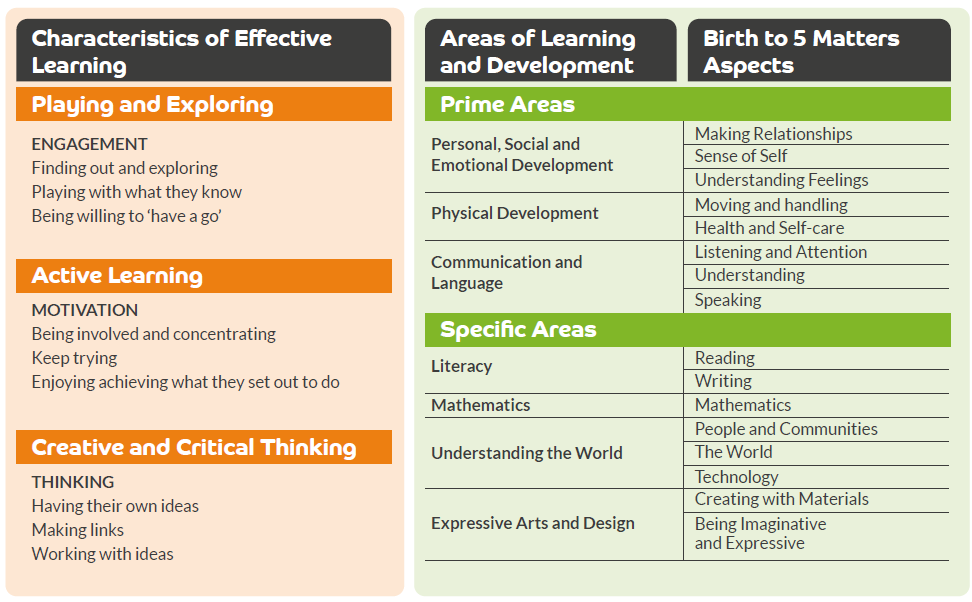
The Early Years Foundation Stage is separated into three prime areas and four specific areas. All areas of learning and development are important and inter-connected. Three areas are particularly crucial for igniting children’s curiosity and enthusiasm for learning, and for building their capacity to learn, form relationships and thrive. These three areas are the prime areas. Adults must also support children in four specific areas, through which the three prime areas are strengthened and applied.
The curriculum focuses on experimental learning, active involvement and developing each child’s;
Skills and understanding.
Personal, social, emotional, physical and intellectual well-being.
Positive attitudes to learning so that they enjoy learning and want to continue to learn.
Self-esteem and self-confidence to experiment, investigate, learn new things and form new relationships.
Creative, expressive and observational skills to encourage their development as individuals with different ways of responding to experiences.
Outdoor learning, where they have first-hand experience of solving real life problems.
The Bowlers Nursery way…
At Bowlers Nursery, we ensure that our children have access to a balanced curriculum that encourages them to learn through play, actively create and learn and think critically. On a daily basis, children are exposed to an exciting and varied sessions, which promotes a careful balance between children exploring and learning independently through play alongside focused activities planned and led by adults. Through observation and sharing play opportunities adults are able to plan and support the children’s next steps in their Bowlers Nursery learning journey.
Learning through play
At Bowlers Nursery the children will demonstrate high levels of engagement in their own learning, they will be exposed to a wide range of vocabulary and have developed the skills to communicate effectively with other children and adults. Children will demonstrate an enjoyment for learning and will be able to have developed a wider sense of the world around them. Children will actively ask questions about the world around them and their learning experiences.
Engaged and curious learners
We want our children leave Bowlers Nursery equipped with the skills, knowledge, experiences and confidence needed to continue their journey through education to go on to develop their personalities and ambitions for their future careers.
Prepared for the future
The EYFS Statutory Curriculum has seven areas of learning and development.
Each area of learning and development must be implemented through planned, purposeful play and through a mix of adult led and child-initiated activity. Practitioners must respond to each child’s emerging needs and interests, guiding their development through warm, positive interaction.
Seven areas of learning
At Bowlers Nursery we provide our children with a broad and stimulating range of resources – both indoors and outside - appropriate to their stage of development. We ensure full coverage of the seven ‘areas of learning’ which include the three Prime Areas: Communication and Language, Physical Development and Personal, Social and Emotional Development; followed by the four Specific Areas: Literacy, Mathematics, Understanding the World and Expressive Arts and Design. All areas of learning and development are equally important.
Resources to support every child’s growth
The revised EYFS 2021 states “In planning and guiding children’s activities, practitioners must reflect on the different ways that children learn and reflect these in their practice.
Three characteristics of effective teaching and learning are:
playing and exploring ...
active learning ...
creating and thinking critically.
Encouraging exploration and curiosity
All staff make regular observations of children in the seven areas of learning.
Observations and assessments are used to inform staff in deciding possible activities and provision that would help the development of that child and to inform future planning.
Learning through observation